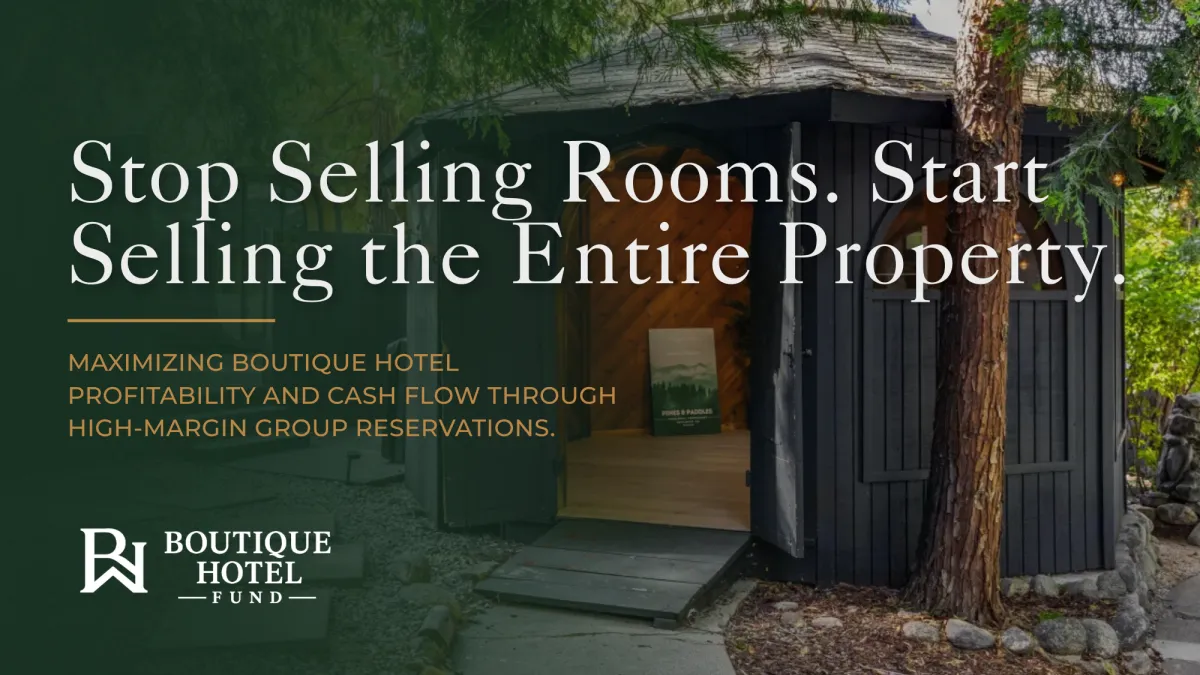
How Boutique Hotels Can Increase Revenue With Group Bookings
Group bookings became one of the most important revenue strategies at The Pinetree Hotel because they allow us to generate premium rates, secure business months in advance, and create greater visibility into future cash flow. Instead of thinking only about how many individual rooms we can sell, we learned to think about how the entire property could serve weddings, retreats, celebrations, and other groups. That shift now influences how I evaluate boutique hotel opportunities.
One of the biggest lessons I have learned from operating The Pinetree Hotel is that not every booking should be treated the same.
When most people think about hotel revenue, they think about occupancy. The goal seems straightforward: fill as many rooms as possible at the best nightly rate you can get.
That matters, but boutique hospitality gives you opportunities to think differently.
At The Pinetree, one of the most important changes we made was developing the property as a destination for groups. Weddings, milestone birthdays, corporate retreats, family gatherings, and full-property buyouts became an important part of our business.
Those bookings changed more than our occupancy. They changed the economics of the property.
Today, group reservations can command approximately one and a half to two times our standard rates. They often book six to twelve months in advance, typically with deposits, and the revenue from group business can cover the hotel's debt service.
That experience has changed how I evaluate boutique hotels and how I think about revenue before we ever acquire a property.
Occupancy Does Not Tell the Whole Story
Hotel operators naturally pay close attention to occupancy.
If you have empty rooms, you are holding inventory that disappears at the end of the night. You cannot sell yesterday's vacant room tomorrow, so there is always pressure to fill as much inventory as possible.
The problem is that focusing too heavily on occupancy can lead you to treat every reservation as equally valuable.
They are not.
A guest booking one cabin for two nights creates one type of revenue opportunity. A group taking over a significant portion of the property for a wedding weekend creates something entirely different.
The group may need multiple rooms. They may use shared spaces. They may stay longer. They may book additional experiences. Most importantly, they are evaluating the property based on something very different from the nightly price of a single room.
Once we started understanding that distinction at The Pinetree, it changed the way we thought about the calendar.
Instead of asking only how quickly we could fill rooms, we started asking whether certain dates might be more valuable if we preserved them for the right type of guest.
Why Boutique Hotels Work Well for Groups
Boutique hotels can have a natural advantage when it comes to group business.
A traditional hotel may be excellent at providing consistent rooms and predictable service, but many group travelers are looking for something more personal.
Think about someone organizing a milestone birthday.
They are not simply trying to find twenty beds.
They want a place where everyone can spend time together. They want spaces where the group can gather in the morning, relax during the afternoon, and sit around a fire at night. They want the property itself to contribute to the celebration.
The same is true for retreats, weddings, and family gatherings.
At The Pinetree, the cabins and shared spaces made that possible. Amenities such as the pool, sauna, cold plunge, pickleball, fire pits, and outdoor gathering areas helped turn the hotel into a place where the group could spend the weekend rather than simply sleep between activities.
That matters because the more important the property becomes to the overall experience, the less the purchasing decision revolves around the price of an individual room.
The guest is evaluating the entire setting.
That creates an opportunity for a well-designed boutique hotel to command a premium.
A Group Is Buying an Experience
If someone needs a room in Idyllwild for Saturday night, they have options.
They can compare hotels based on nightly rates, reviews, photographs, location, and amenities. The room is the primary product.
A group planning a wedding weekend or company retreat approaches the decision differently.
They may need a property capable of accommodating many people while still giving everyone places to gather. They may want privacy. They may want common spaces. They may want something memorable enough that the hotel becomes part of the event itself.
That substantially narrows their options.
This is where the economics begin to change.
At The Pinetree, group bookings can achieve pricing approximately one and a half to two times our standard rate.
The premium is not simply because we decided to charge more.
It comes from offering something different.
Instead of selling a collection of individual rooms, we are offering access to an environment where the group can have a shared experience.
When the value proposition changes, the pricing opportunity changes with it.
Booking Months Ahead Changes the Business
The premium rate is only one benefit of group business.
Timing may be equally important.
Individual leisure travelers often book relatively close to their arrival date. Groups tend to plan much further ahead because organizing dozens of people requires more coordination.
At The Pinetree, group reservations can come six to twelve months before the actual stay and are commonly secured with deposits.
That gives us something extremely valuable as operators: visibility.
If I know months in advance that several important weekends are already committed, I have a much clearer picture of future revenue before I begin selling the remaining rooms.
That changes how we can operate.
It provides a base of booked business that allows us to make better pricing decisions around the remaining inventory. It also reduces some of the uncertainty that naturally comes with hospitality, where revenue can otherwise depend heavily on what happens during the next several weeks.
At The Pinetree, the group business became significant enough that those reservations can cover the property's debt service.
That is an important distinction.
Once a meaningful portion of your fixed obligations is supported by business booked months in advance, the rest of the calendar looks different.
Why We Do Not Open Every Weekend Immediately
One of the more counterintuitive decisions we made was limiting how far in advance guests can book certain standard weekend stays.
Most people would assume that if someone wants to give you money for a room, you should take the reservation.
Sometimes that is the right decision.
Sometimes it is not.
At The Pinetree, we generally protect weekends beyond roughly 90 days rather than immediately opening all of them for ordinary individual bookings. The reason is simple. A future weekend may ultimately be worth considerably more as a group buyout.
Imagine accepting a handful of individual room reservations six months in advance.
Those bookings may look like a win.
But if a wedding or corporate retreat later wants to take over the property for the same weekend, the earlier reservations can prevent you from accepting a substantially more valuable booking.
You filled inventory, but you may have reduced revenue.
Protecting the calendar gives us time to pursue the higher-value opportunity first.
As the arrival date gets closer, the decision changes. If the group demand has not materialized, we can make the remaining inventory available to individual travelers.
That approach requires patience because an empty future calendar can feel uncomfortable.
But an empty room six months from now is not the same thing as an empty room tonight.
Understanding that difference has become an important part of our revenue strategy.
Group Revenue Starts With the Property Design
You cannot simply decide that you want group business after buying a hotel.
The property has to support it.
This is one of the things I now think about when evaluating boutique hotel acquisitions.
I want to understand how guests move through the property and whether there are natural places where people can gather. I want to know whether the hotel can accommodate a group without making everyone feel like they are scattered across unrelated spaces.
The room count matters, but the common areas matter too.
A property may have beautiful guestrooms but very little group potential if there is nowhere for twenty or thirty people to comfortably spend time together.
This is why amenities can have value beyond the individual guest experience.
A fire pit gives a group somewhere to gather at night. A pool creates an afternoon activity. A sauna or cold plunge can become part of a wellness retreat. Flexible outdoor spaces can support celebrations, meetings, and social events.
Each improvement has to make sense financially, but I do not look at amenities simply as features anymore.
I think about how they change the ways a property can be used.
If an amenity helps us reach a higher-value customer or makes a full-property experience more compelling, its contribution may extend well beyond the nightly rate of a room.
Marketing a Group Stay Is Different
Once we recognized the importance of group business, we also had to think differently about how we marketed The Pinetree.
A photograph of a beautiful hotel room may convince a couple to book a weekend.
It does not necessarily show someone planning a 40th birthday what it would feel like to bring their closest friends to the property.
Group customers need to see the experience.
They need to imagine the dinner, the pool afternoon, the retreat, the wedding weekend, or the gathering around the fire.
That means the marketing should show the property being used the way you want people to book it.
At The Pinetree, social media became particularly useful because we could show more than rooms. We could show celebrations, gatherings, shared spaces, amenities, and the atmosphere of the hotel.
We also worked with influencers to create content and then used content that performed well in targeted Meta campaigns. The podcast discussion highlighted targeting people with specific reasons to organize a celebration, such as engagements and upcoming birthdays.
What I like about this approach is that it connects marketing to a specific revenue opportunity.
We are not simply trying to get more people to know the The Pinetree name.
We are trying to reach people who have a reason to book the type of stay The Pinetree is particularly good at providing.
The Best Marketing Shows What the Property Can Become for the Guest
One thing hospitality marketing gets wrong is focusing too heavily on what the property has instead of what the guest can do with it.
A cold plunge is a feature.
A weekend wellness retreat with friends is an experience.
A collection of cabins is a feature.
Having your entire family together in one property for a milestone celebration is an experience.
An outdoor gathering area is a feature.
A company bringing its team together for a retreat is an experience.
That distinction has influenced the way I think about both property design and marketing.
The more clearly we can show how someone could use The Pinetree for something meaningful, the easier it becomes for the right guest to see value in booking the property.
This becomes even more important for groups because the person making the reservation is often responsible for choosing the experience for everyone else.
They need confidence that the property will work.
Good hospitality marketing helps them picture that before they ever arrive.
Group Business Can Make Seasonality More Manageable
Seasonality is part of operating a leisure hotel.
Some weekends naturally attract demand. Others require more effort.
Group business can help provide another layer of demand because groups are not always making their decisions based on the same factors as individual leisure travelers.
A wedding has a date.
A birthday happens at a certain time of year.
A company may decide that a quieter period is actually ideal for a retreat.
That gives operators another way to think about periods that might otherwise be more difficult to fill.
A well-structured group strategy does not eliminate seasonality, but it can make the revenue mix more diverse.
That matters because I do not want the performance of a hotel to depend on one type of customer.
If individual leisure demand is strong, that is valuable. If we can layer group bookings on top of that demand and secure some of those reservations well in advance, the business becomes more predictable.
That predictability has value.
How Group Potential Affects the Hotels I Look At Today
The Pinetree changed the questions I ask when looking at another boutique hotel.
I still want to understand the existing revenue, expenses, occupancy, average daily rate, condition of the rooms, renovation requirements, and market demand.
But I also want to know how the entire property could be used.
Could a company buy out the hotel for a retreat?
Could someone host a milestone birthday there?
Would a wedding party want to take over the property?
Are there spaces where groups can gather?
Could we add amenities that make a full-property experience significantly more compelling?
Does the layout give guests enough privacy while still allowing the group to spend time together?
Those questions are now part of evaluating the upside.
A hotel that looks average based on its current room revenue may become much more interesting if the physical property supports a group strategy that the existing operator has never developed.
That is exactly the type of operational opportunity I look for.
Revenue Growth Is About More Than Raising Rates
When investors talk about improving a hotel, the discussion can quickly become focused on increasing room rates.
There is nothing wrong with increasing rates when the property and market support it.
But I think the better question is how you can make the hotel more valuable to the customer.
If you improve the experience enough that someone wants to bring an entire group to your property, you have created a new source of demand rather than simply asking an existing customer to pay more.
That is a very different type of revenue growth.
You are changing how the asset is used.
For The Pinetree, developing group business allowed us to generate premium pricing while creating more predictable future bookings. It also helped us take advantage of the property's physical characteristics in ways that would not have been possible if we thought exclusively in terms of selling one cabin at a time.
That is the kind of value creation I find compelling in boutique hospitality.
What The Pinetree Taught Me About Group Revenue
Before operating The Pinetree, I understood the basic concept of group bookings.
What I did not fully appreciate was how much they could influence the entire business.
They affect pricing.
They affect the booking calendar.
They affect marketing.
They affect the types of amenities worth creating.
They affect how far ahead we can see revenue.
They even affect the type of boutique hotels I find interesting as investment opportunities.
Today, I do not look at a hotel and simply ask how many rooms it has or what those rooms could rent for.
I want to understand how people could experience the property together.
The Pinetree showed us that when a boutique hotel becomes the setting for someone's wedding, retreat, birthday, or family gathering, the hotel is providing something much more valuable than a night's accommodation.
That creates a different relationship with the guest and a different economic opportunity for the operator.
For us, group business has become one of the clearest examples of why thoughtful operations matter so much in boutique hotel investing.
The real estate gives you the property.
What you choose to do with it determines how much opportunity that property can ultimately create.