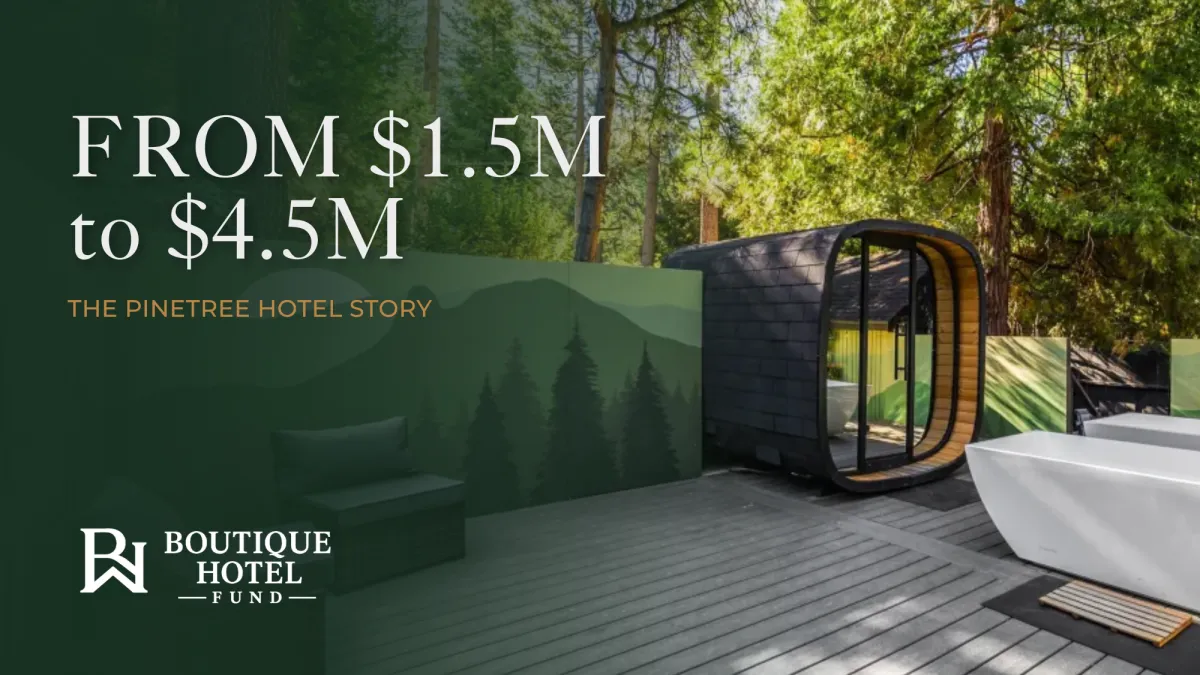
How We Turned a $1.5M Boutique Hotel Into a $4.5M Asset
We acquired The Pinetree Hotel for approximately $1.5 million and repositioned it by improving the guest experience, adding amenities, building a recognizable brand, growing direct bookings, and developing a higher-value group business. Today, the property is valued at more than $4.5 million and is approaching $1 million in annual revenue. The biggest lesson was that value creation in boutique hotels comes from improving both the real estate and the operating business behind it.
When my business partner, Isaac Silverman, and I purchased The Pinetree Hotel in Idyllwild, California, in 2023, we paid approximately $1.5 million. Today, the property is valued at more than $4.5 million and is on track to generate more than $1 million in annual revenue with NOI margins around 45%.
Those numbers are important, but they do not tell the whole story.
We did not create that value by purchasing a hotel and waiting for the market to appreciate. The Pinetree was an underperforming hospitality asset that we believed could become something much more valuable with the right combination of design, operations, marketing, and revenue strategy.
The experience changed the way I think about real estate investing. It also gave us a framework for the types of boutique hotel opportunities we pursue today.
From Short-Term Rentals to Boutique Hotels
Before The Pinetree, I spent roughly five years building and operating a portfolio of more than 20 short-term rentals.
Short-term rentals were my introduction to hospitality. They taught me how much small operational decisions matter. Pricing, photography, design, guest communication, reviews, maintenance, and cleanliness all influence how a property performs.
As the portfolio grew, however, I started seeing another side of the model.
Every new property meant another acquisition, another financing package, another set of utilities, another maintenance schedule, and another property that had to be managed independently. We were growing the portfolio, but we were also multiplying the number of moving pieces.
That made me start thinking about scale differently.
Instead of acquiring more individual houses, what if we concentrated our capital and operating effort into a larger hospitality asset? A boutique hotel could give us multiple revenue-producing units under one roof, with one operating structure, one brand, and one overall strategy.
There was also a fundamental difference in how the asset could create value.
A short-term rental may produce excellent cash flow, but when it is eventually sold, it is still often valued primarily as residential real estate. The market may care more about what a similar home down the street sold for than how well you operated the property.
Hotels are different. The operating performance of the business has a much more direct relationship with the value of the real estate. If you can increase revenue, improve margins, and grow NOI, you have the potential to create significant value in the underlying asset.
That was one of the ideas that attracted me to boutique hotels in the first place.
Finding the Opportunity at The Pinetree
When we first evaluated The Pinetree, we were not looking at a polished hotel that had already reached its potential. That was exactly why it interested us.
The property was located in Idyllwild, a mountain community that draws visitors from Southern California. It already had something that is difficult to create from scratch: character. The cabins sat among mature pine trees, and the layout gave the property a natural sense of privacy while still allowing guests to gather together.
We believed the physical property could support a much stronger hospitality concept than what was there at the time.
That is an important distinction in the way I evaluate boutique hotel investments today. I am not necessarily looking for the hotel with the strongest existing operation. I am looking for situations where there is a meaningful difference between what the property is currently producing and what it could produce with better execution.
Sometimes the opportunity is operational. Sometimes the branding is weak or the guest experience has not kept pace with what modern travelers want. Sometimes the hotel depends heavily on third-party booking platforms and has never developed its own audience. In other situations, the property has physical spaces that could generate considerably more revenue if they were used differently.
The Pinetree had several of those opportunities at once.
We did not want to simply renovate the rooms and put the property back on the market with higher nightly rates. We wanted to rethink what the entire stay could feel like.
Creating a Property People Want to Experience
One of the biggest shifts we made was thinking beyond the room itself.
A hotel room is obviously important, but in experiential hospitality, the room is only one part of what the guest is buying. If you can create an environment where people genuinely want to spend time at the property, the hotel starts competing differently.
At The Pinetree, we invested in amenities and shared spaces that gave guests more reasons to stay on the property and more ways to enjoy it. The experience grew to include the pool, sauna, cold plunge, pickleball, fire pits, wellness areas, and outdoor gathering spaces.
These additions were not chosen simply because they looked good in photographs. They helped us change the way guests could use the hotel.
A couple could come for a mountain weekend and spend much of their stay enjoying the property. A group of friends could gather around the fire pits. A corporate group could use the hotel for a retreat. A family could take over multiple cabins for a celebration. A wedding party could make The Pinetree part of the event itself rather than simply a place where everyone slept afterward.
Once the hotel becomes part of the reason for the trip, you are no longer competing solely on the nightly rate of a room. You are creating an experience that gives guests a reason to choose your property specifically.
That became central to The Pinetree strategy and ultimately influenced nearly every other part of the business.
Building the Audience Alongside the Hotel
Another major lesson from The Pinetree was that marketing cannot be treated as something that begins after construction ends.
We started marketing the concept while the property was still being transformed. We created renderings and put together a simple website that allowed people to see what we were building. This gave us an opportunity to create interest around The Pinetree before every physical improvement had been completed.
One of the earliest results confirmed that there was real demand for what we were creating.
Before the property was finished, we received a weekend booking worth roughly $20,000 from guests who had not yet seen the completed hotel.
For me, that booking represented much more than revenue. It was validation that someone could see the vision for the property and was willing to commit significant money to experience it before the final product even existed.
It also changed how I think about marketing new hotel projects.
If you wait until opening day to begin building awareness, you are starting from zero at exactly the moment you need occupancy. I would rather build the brand and audience while the physical property is being improved. By the time the hotel is ready, potential guests should already understand what makes the property different and why they might want to stay there.
Why Direct Bookings Became So Important
As The Pinetree grew, building our own audience became increasingly important.
Online travel agencies are valuable distribution channels, especially when a hotel is establishing itself. They put the property in front of people who may never have discovered it otherwise. The problem comes when a property becomes completely dependent on them.
We wanted to build a business where people knew The Pinetree by name and sought it out directly. Social media became a major part of that strategy, and the property eventually built an audience of nearly 50,000 followers across Instagram and TikTok.
That audience gave us a direct connection with people who were interested in the property. Past guests could remain connected with The Pinetree, future guests could follow what was happening, and the content we created could continue introducing the hotel to new people without depending entirely on a third-party platform for visibility.
Boutique hotels are particularly well suited for this because the property itself gives you interesting material to market. The cabins, sauna, cold plunge, outdoor spaces, events, and surrounding destination all become part of the hotel's story. The same investments that improve the guest experience can also make the property easier to discover and remember.
Direct bookings can also improve the economics of the operation by reducing the fees associated with third-party distribution.
Over time, I have come to view the audience surrounding a boutique hotel as part of the asset itself. A recognizable property with a loyal following and a growing direct-booking business is fundamentally different from a hotel that relies almost entirely on someone else's platform to fill its rooms.
How Group Business Changed the Revenue Model
One of the biggest opportunities we discovered at The Pinetree was group business.
The layout of the hotel made it particularly well suited for weddings, milestone birthdays, corporate retreats, family gatherings, and full-property buyouts. These guests behave very differently from someone searching for a single room for a weekend.
When someone is looking for one room, they may compare The Pinetree with several nearby hotels based on price, location, amenities, and reviews. A group looking for a place to bring dozens of people together has a much narrower set of options. They are choosing the environment for an entire experience.
That changes what the property can command.
At The Pinetree, group bookings can generate approximately one and a half to two times our normal rates. They are also frequently secured six to twelve months in advance with deposits, which gives us greater visibility into future revenue.
The impact became significant enough that group bookings could cover the property's debt service.
That changed how we managed the calendar itself. Instead of automatically opening every future weekend for individual reservations, we became more strategic about preserving desirable dates for potential group buyouts. The Pinetree does not accept standard weekend bookings beyond roughly 90 days out, which allows us to protect valuable dates for groups that may generate substantially more revenue.
It is a good example of why operating a hotel well involves much more than increasing occupancy. Sometimes the better decision is not filling a room as quickly as possible. It is understanding which customer can create the greatest value from that inventory and structuring the booking strategy accordingly.
Marketing Group Experiences Differently
Group business also required a different approach to marketing.
Someone planning a wedding, milestone birthday, or retreat is not necessarily searching for the same thing as a typical leisure traveler. The marketing has to reflect the experience they are trying to create.
We found that social content could be particularly useful for showing people what a group stay at The Pinetree actually looked like. Instead of focusing exclusively on individual rooms, the marketing could show gatherings, events, celebrations, and the shared spaces that made those experiences possible.
We also worked with influencers to create content and used strong-performing content in targeted Meta advertising. This allowed us to reach people who were more likely to have a specific reason to organize a group trip or celebration.
What I like about that approach is how measurable it can be. We can see which content generates interest, which audiences respond, and which campaigns produce actual inquiries and reservations. For a growing boutique hotel, I would much rather understand how marketing contributes to revenue than generate attention without knowing whether it ultimately turns into bookings.
The Numbers Improved Because the Business Improved
The most important part of The Pinetree story is the relationship between all these changes.
There was no single renovation that suddenly made the hotel worth millions more.
The physical improvements made the property more desirable. The amenities strengthened the guest experience. The experience gave us better material to market. The marketing helped us build an audience. That audience supported more direct bookings. The layout and positioning created opportunities for higher-value group reservations. Better revenue combined with disciplined operations helped improve NOI.
Those pieces worked together.
That is ultimately how we went from acquiring The Pinetree for approximately $1.5 million to owning an asset now valued at more than $4.5 million.
It is also why boutique hotels are so interesting to me as an investment class. You have the real estate, but you also have an operating business that you can actively improve.
If I purchase an apartment building, there are certainly ways to increase its value, but there are limits to how differently I can position one apartment from another. Boutique hospitality gives an operator more ways to influence performance. The brand, guest experience, customer acquisition strategy, revenue mix, amenities, group business, and operating margins can all change the financial performance of the property.
When those improvements increase NOI, they can also increase the value of the real estate.
What Did Not Go According to Plan
It would be easy to tell The Pinetree story based only on the purchase price, current valuation, and revenue growth.
That would leave out an important part of the experience.
The project was difficult. Our SBA financing took longer than expected. Insurance costs increased substantially. Contractor bids varied widely. Construction took longer than we originally projected, and the project went over budget.
Those experiences changed the way I underwrite deals today.
I now expect that there will be surprises. I want more contingency in the renovation budget and more room in the construction timeline. I also want investors to understand that a major repositioning takes time. The first year of owning an underperforming hotel may involve significant work before the final business plan begins showing up in the financial results.
That does not necessarily mean the investment thesis is wrong. It means you have to evaluate the project on the appropriate timeline.
When I look at a boutique hotel investment, I am much more interested in what the business can become over several years than whether every renovation milestone went perfectly during the first few months. Hospitality involves real properties, real employees, real construction, real guests, and real operating challenges. The underwriting has to acknowledge that reality.
What The Pinetree Taught Me About Boutique Hotel Investing
The Pinetree changed how I look at real estate.
I no longer see a boutique hotel simply as a building containing a certain number of rooms. I see the real estate and the operating business together.
When I evaluate a potential acquisition today, I want to understand where value is being left on the table. The hotel may have great real estate but weak branding. The rooms may perform reasonably well while the property has never developed a group strategy. The operator may be paying a significant portion of revenue to online travel agencies because no one has invested in direct marketing. There may also be unused spaces that could become amenities or generate additional revenue.
Those are the situations that interest me.
The Pinetree demonstrated what can happen when you identify several of those opportunities within one property and execute on them together.
We purchased an approximately $1.5 million hotel and transformed much more than the physical property. We changed how it was positioned, how guests experienced it, how people discovered it, and how the business generated revenue.
Today, The Pinetree is valued at more than $4.5 million and is approaching more than $1 million in annual revenue.
I am proud of those results, but the most valuable outcome may be the playbook the experience gave us.
The lessons from The Pinetree now influence how we evaluate, acquire, reposition, market, and operate the boutique hotels we pursue next.