
BLOGS
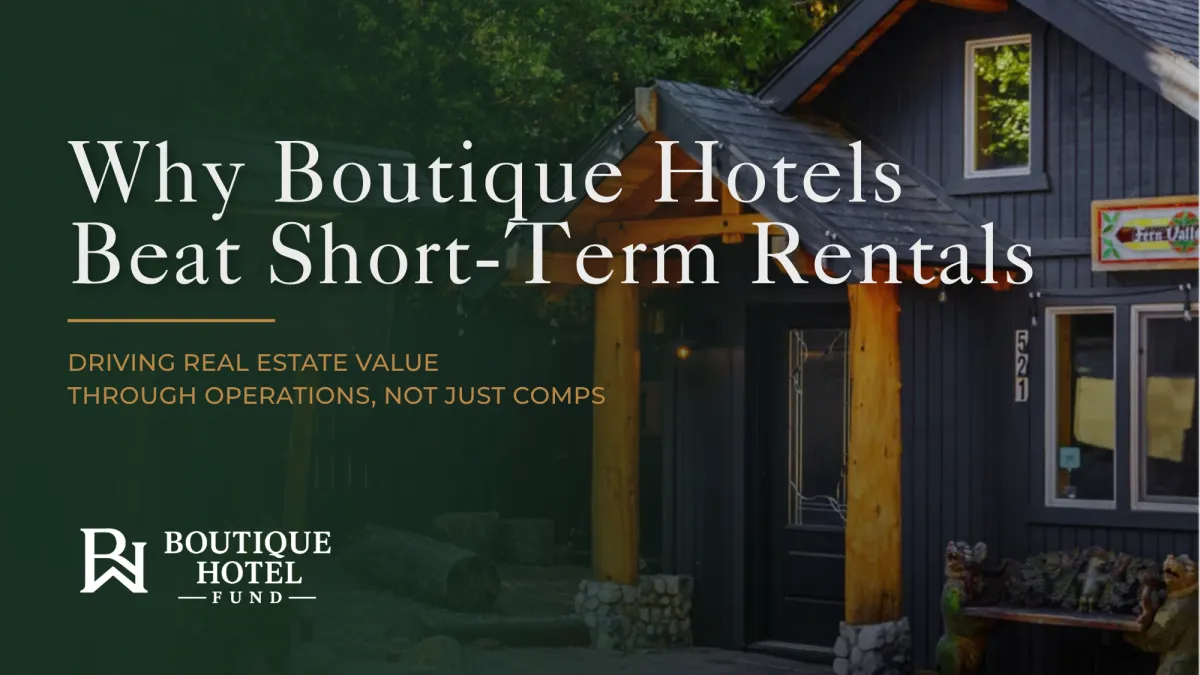
Why I Moved From 20+ Short-Term Rentals to Boutique Hotels
Operating more than 20 short-term rentals taught me the fundamentals of hospitality, but it also showed me the challenges of scaling one individual property at a time. Boutique hotels gave me a way to concentrate operations, build a recognizable brand, create multiple revenue streams within one asset, and connect operating performance more directly to real estate value. The transition was not about leaving short-term rentals behind. It was about applying everything I learned from them to a model I believed could scale differently.
For about five years, I built and operated a portfolio of more than 20 short-term rentals.
That experience taught me a lot about hospitality. I learned how much design matters, how pricing affects demand, how reviews influence bookings, and how small operational decisions can completely change the guest experience.
Short-term rentals also gave me an important education in what happens when you start trying to scale.
As the portfolio grew, so did the complexity. Every new property meant another acquisition, another loan, another set of utilities, another maintenance schedule, another cleaning team, and another collection of problems that had to be managed independently.
At some point, I started asking myself a different question.
Instead of continuing to acquire individual homes one at a time, could we take what we had learned from short-term rentals and apply it to a larger hospitality asset?
That question eventually led me into boutique hotels and ultimately to The Pinetree Hotel in Idyllwild, California.
The move changed the way I think about hospitality, operations, and real estate investing.
Occupancy Does Not Tell the Whole Story
I did not start by operating hotels.
Short-term rentals were where I learned the business.
When you operate an individual vacation rental, there is nowhere to hide from the guest experience. Every detail matters because guests notice everything.
The quality of the photography affects whether someone clicks on the listing. The design affects whether the property feels memorable. The cleanliness affects the review. Communication affects how the guest feels before they even arrive. Pricing affects whether you fill the calendar or leave money on the table.
You quickly learn that owning the real estate is only one part of the business.
The operation determines how that real estate performs.
That lesson has stayed with me throughout my transition into boutique hotels.
A well-located property can still perform poorly if the guest experience is weak. A beautiful property can struggle if the marketing is ineffective. A good concept can lose money if the operation is inefficient.
Short-term rentals forced me to understand all of those pieces together.
The Challenge Started When We Tried to Scale
One successful short-term rental can be relatively manageable.
Twenty is different.
Every time we added another property, we added another set of moving parts.
The homes were individual assets, often in different locations, with different financing structures, different maintenance needs, and different operating considerations.
If the air conditioning failed at one property, that was one problem.
If a cleaner did not show up at another property, that was a different problem.
If a third property needed repairs while another had a guest issue, those problems did not become easier simply because the portfolio was larger.
In some ways, the operation became more complicated as we grew.
That made me start questioning what scale really meant.
Owning more properties certainly increased the size of the portfolio, but it did not necessarily create the operational efficiency I was looking for.
I began wondering whether there was a way to consolidate those efforts into fewer, larger assets.
Boutique Hotels Changed the Scale Equation
Boutique hotels gave me a different way to think about growth.
Instead of purchasing ten individual houses in separate transactions, you can potentially acquire one property containing multiple revenue-producing units.
That changes the operating structure.
You have one location, one overall renovation plan, one brand, and a more centralized team.
The rooms may be separate products, but they are all part of the same business.
That concentration appealed to me.
If we were going to put significant effort into hospitality operations, marketing, design, and guest experience, I wanted to know whether that same effort could influence a larger asset.
Boutique hotels gave us that opportunity.
The work did not disappear. Hotels have their own operational challenges and can be substantially more complicated in other ways.
But the model allowed us to focus our efforts on improving one hospitality business rather than managing a growing collection of independent houses.
The Valuation Model Was Different Too
The operational scale was only part of what attracted me to hotels.
The other major difference was how value could be created.
A short-term rental may be an excellent business. You may have strong occupancy, great reviews, and healthy cash flow.
But when you eventually sell the property, it may still be valued primarily as a house.
The buyer looks at the neighborhood. The appraiser looks at comparable home sales. A property down the street can have a significant influence on what your asset is worth.
That can limit how much of the value you created through operations is ultimately reflected in the real estate.
Hotels work differently.
A hotel is both real estate and an operating business.
Revenue matters.
Expenses matter.
Net operating income matters.
If you can improve the business and increase NOI, you can potentially increase the value of the underlying property.
That relationship between operations and valuation was extremely compelling to me.
It meant the work we were already doing in hospitality could potentially create value beyond the monthly cash flow.
The Pinetree Hotel Became Our First Real Test
The Pinetree Hotel became the property where we could put that idea into practice.
When we acquired it in 2023, we paid approximately $1.5 million.
We were not purchasing a finished hotel that was already operating at its full potential.
That was part of the opportunity.
The property had characteristics we liked. It was located in Idyllwild, a mountain destination within driving distance of major Southern California markets. It had cabins, mature pine trees, outdoor areas, and the kind of setting that could support a much stronger hospitality experience.
What we saw was a gap between the property's existing operation and what we thought the property could become.
That gap is now one of the things I look for in boutique hotel investing.
I am interested in properties where better execution can materially change the business.
I Started Looking Beyond the Room
Short-term rentals had trained me to think deeply about the individual unit.
How does the bedroom look?
How comfortable is the living room?
Does the kitchen photograph well?
Would a guest choose this house over the alternatives?
With a boutique hotel, I had to expand that thinking.
The room still matters, but the entire property becomes part of the product.
At The Pinetree Hotel, we began thinking more about what guests could do once they arrived.
That led us to improve the pool and develop amenities and shared experiences around the property, including the sauna, cold plunge, pickleball, fire pits, wellness spaces, and outdoor gathering areas.
Those investments changed the way the hotel could be used.
It could still serve the couple coming to Idyllwild for a weekend.
But it could also become a destination for a birthday, wedding, family gathering, corporate retreat, or group getaway.
That was a very different revenue opportunity from anything I had experienced with an individual short-term rental.
One Property Could Serve Several Types of Guests
One of the things I came to appreciate about boutique hotels is how many different customer segments one property can potentially serve.
An individual traveler may want a quiet mountain weekend.
A couple may want an anniversary trip.
A group of friends may want to celebrate a birthday.
A company may need a retreat.
A family may want a place where everyone can stay together.
A wedding party may want to take over most or all of the property.
The physical asset stays the same, but the way guests use it can change dramatically.
That creates opportunities to think beyond a simple nightly room rate.
At The Pinetree Hotel, group bookings became an important part of the business. Those reservations can command approximately one and a half to two times standard rates and may be booked six to twelve months ahead.
That kind of opportunity is difficult to replicate with one individual vacation rental.
The hotel gives you a larger canvas.
Marketing Became More Interesting
The transition into boutique hotels also changed the way I thought about marketing.
With a short-term rental, much of the marketing can revolve around the listing itself.
You need good photographs, strong reviews, accurate descriptions, competitive pricing, and visibility on the major booking platforms.
A boutique hotel gives you an opportunity to build something much broader.
You can build a brand around the property.
You can build an audience.
You can create content around the guest experience, the amenities, the destination, the events, and the people using the property.
At The Pinetree Hotel, that eventually helped us build a social audience of nearly 50,000 people across Instagram and TikTok.
The significance of that number is not simply that a lot of people follow the property.
The value is that people know the hotel by name.
That gives us an opportunity to build direct demand rather than depending entirely on someone searching for an available room through a third-party platform.
I Started Thinking About the Brand as an Asset
That was another major shift for me.
With an individual short-term rental, you can certainly create a recognizable property and build repeat business.
But with a boutique hotel, the brand can become much more central to the operation.
Guests can follow the hotel.
They can return for different occasions.
They can recommend it to friends.
They can see an event at the property and begin imagining their own event there.
The more recognizable the hotel becomes, the more opportunity you have to build demand around the name rather than simply around the destination.
That matters because I do not want our hotels to compete only on price.
If someone searches for an available room and sees twenty comparable options, price becomes an easy way to make the decision.
If that person already wants to stay at The Pinetree Hotel, the decision is different.
Now the question becomes whether we have availability.
That is the type of demand I want to create.
The Operation Became a Bigger Part of the Investment Thesis
The deeper I got into boutique hotels, the more I realized that the operation itself was where a significant amount of value could be created.
Real estate investors naturally think about the purchase price, financing, renovation, and eventual sale.
All of those things matter.
But in boutique hospitality, there are additional levers.
You can improve pricing.
You can improve the guest experience.
You can change the revenue mix.
You can increase direct bookings.
You can develop group business.
You can add amenities.
You can strengthen the brand.
You can improve operating efficiency.
Each of those changes can influence NOI.
When NOI improves, the real estate can become more valuable.
That is what made the model so compelling to me.
Instead of separating the real estate investment from the hospitality business, the two reinforce each other.
Bigger Did Not Mean Easier
Moving into boutique hotels did not eliminate operational challenges.
It created new ones.
Our renovation of The Pinetree Hotel took longer than expected.
The project went over budget.
Our SBA financing took longer than we anticipated.
Insurance costs increased substantially.
Contractor bids varied dramatically.
There were plenty of moments when owning another short-term rental would have looked much simpler.
But the difficulty did not change the reason we made the transition.
The question was never whether boutique hotels were easier.
The question was whether the work could create more value.
For me, that answer became clearer as the property evolved.
The Numbers Started Reflecting the Work
We acquired The Pinetree Hotel for approximately $1.5 million.
Today, the property is valued at more than $4.5 million and is approaching more than $1 million in annual revenue with NOI margins around 45%.
That did not happen because of one decision.
It came from improving several parts of the business at the same time.
We improved the physical property.
We strengthened the guest experience.
We developed amenities.
We built the brand.
We grew an audience.
We increased direct demand.
We developed group revenue.
We became more deliberate about how we managed the booking calendar.
The value was created through the operation.
That experience confirmed the opportunity I had started seeing when I was still operating short-term rentals.
Short-Term Rentals Still Shaped the Way I Operate
I do not view the move into boutique hotels as leaving short-term rentals behind.
I view it as building on what they taught me.
The same principles still matter.
Guests still notice details.
Design still influences purchasing decisions.
Reviews still matter.
Pricing still matters.
Fast communication still matters.
A bad guest experience can still undo a lot of good marketing.
The difference is that those lessons are now being applied across a larger hospitality asset.
Everything I learned from operating more than 20 short-term rentals became useful when we started operating hotels.
The scale changed.
The fundamentals did not.
I Also Started Thinking Differently About My Time
There was another important part of the transition.
As an investor and operator, your time is limited.
You can spend that time managing a large collection of smaller assets or concentrate it into fewer opportunities where the potential impact of your decisions may be greater.
That does not mean one approach is universally better.
It depends on what you want.
Some investors love owning individual short-term rentals. They enjoy the flexibility, the control, and the ability to build their portfolio one property at a time.
For me, I became increasingly interested in larger opportunities where we could apply the same operating skills across more revenue-producing units.
Boutique hotels fit that direction.
I could spend time thinking about one brand, one guest experience, one marketing engine, and one larger asset.
That became a better fit for what I wanted to build.
Why Partnerships Became More Important
Larger opportunities also changed the way I thought about partnerships.
When you own a small property, it is tempting to do everything yourself.
As the projects become larger, that becomes much harder.
There are too many areas that require real expertise.
Design, operations, construction, finance, marketing, revenue management, and investor relations all matter.
I became more comfortable with the idea that I did not need to control 100% of every opportunity.
I would rather own a meaningful piece of a larger, well-executed project with the right partners than own all of something smaller simply because I wanted complete control.
That shift has become increasingly important as we pursue larger boutique hotel opportunities.
The goal is not to personally do everything.
The goal is to build the strongest team for the asset.
What I Look for Now
Today, when I evaluate a boutique hotel, I am looking at much more than the existing financial statements.
I want to understand what the current operator may be missing.
I want to know whether the property has a compelling setting and whether the guest experience can be improved.
I want to understand the current dependence on online travel agencies and whether we can build more direct demand.
I look at whether the layout could support groups, events, retreats, or full-property buyouts.
I think about amenities, branding, marketing, pricing, and how the property could be positioned differently.
The existing numbers matter.
But I am equally interested in the gap between those numbers and what the hotel might produce after better execution.
That gap is where much of the opportunity can exist.
Why Boutique Hotels Became the Next Step for Me
My move from short-term rentals into boutique hotels was not the result of one bad experience or one great deal.
It was an evolution.
Short-term rentals taught me how hospitality works at the property level.
Scaling them taught me where the operational challenges begin.
Boutique hotels gave me a way to apply those lessons to larger assets where improvements to the business could potentially create significant value in the real estate.
The Pinetree Hotel became the proof of concept.
We took what we had learned from years of operating short-term rentals and applied it to one underperforming hotel.
The result was more than a successful renovation.
It changed the direction of how I wanted to invest.
Today, I am much more interested in finding boutique hotels where better operations, stronger branding, direct marketing, experiential amenities, and new revenue strategies can change the performance of the property.
I still think like a short-term rental operator in many ways.
I just apply those lessons on a different scale now.
And that is ultimately why boutique hotels became the next chapter for me.

The Future of Boutique Hospitality Starts Here
Join our investor community and start building wealth through hotels that inspire connection and deliver exceptional returns.
“Transforming boutique hotels into thriving destinations that inspire connection and deliver exceptional returns.”
QUICK LINKS
CONTACT INFO
© 2025 Boutique Hotel Fund. All rights reserved.
“Transforming boutique hotels into thriving destinations that inspire connection and deliver exceptional returns.”
QUICK LINKS
CONTACT INFO
© 2025 Boutique Hotel Fund. All rights reserved.